
Lake County Expected Versus Actual Release
A projected date is a forecast or eligibility point. An actual release date records a custody event that has occurred. ODRC combines two meanings in its public field named Expected Release Date/Parole Eligibility Date. For a definite modern sentence, it may reflect a calculated expected date. In an old-law or life case, the same field may mark when the Parole Board can consider release. Eligibility does not mean parole was granted.
Other ODRC fields also have narrow meanings. POA/PRD Date means parole on or after or projected release date. A next hearing or review month is a month for Board action, not a promised departure. The expiration of supervision term marks the outer end of APA control, which may occur long after prison release. For a completed departure, reconcile current status, parole or release detail, supervision start, and the sentencing docket.
Parole Board timing needs its own check. Ohio release-consideration hearings generally occur each month, and a future hearing month may be reviewed before the displayed month. If parole is denied, the Board may set a later hearing or a projected release date within the governing rule. A Board date remains discretionary. It can be accelerated or rescinded and does not create an entitlement to leave custody. Read the latest hearing or review type and result on the individual ODRC record, then obtain the official minute when the outcome matters. The court docket may add a separate order that also affects the calculation. “Granted,” “denied,” “continued,” and “rescinded” describe different actions and should not be substituted for one another.
Find a Lake County Projected Date
The correct path changes with custody. The Lake County jail does not publish a sentence calculator. ODRC does publish sentence and future-date fields for people in state custody. A federal sentence uses the BOP Inmate Locator, while a pretrial federal case depends on the court and USMS holding path. Do not use one system as a substitute for another.
- Identify whether the person is pretrial, serving a Lake County jail term, or serving an ODRC prison term. Read the latest entry in the Lake County Common Pleas case search if the status is uncertain.
- For ODRC, open the Ohio Offender Search. Use the ODRC number when known, or search by name and County of Commitment set to Lake.
- Open the matching record and compare name, date of birth, ODRC number, docket, sentence, and jail-time credit.
- Copy the full label and value for
Expected Release Date/Parole Eligibility Date. Also check parole or release detail, hearing month, and any POA/PRD date. - For a local jail sentence, get the certified sentencing entry from the correct court and ask Lake County Jail Records how the stated credit and term were applied.
- Confirm an actual jail departure in the sheriff's Releases Year to Date register, or use ODRC status and release detail for state custody.
The broader Lake County release record path can help determine whether a date reflects bond, sentence completion, a transfer, or another legal event. Absence from a live custody roster is not a release date.
Note: Use the field label with the date because parole eligibility, expected release, transfer eligibility, and supervision expiration are not interchangeable.
Lake County ODRC Date Labels
ODRC's definitions are essential when a Lake County record contains several dates. Earliest Possible Transfer Date concerns Transitional Control. TC/TT Sentence Expiration is a projected release from a halfway house. Expired Stated Term concerns the term after recognized credit. None should be shortened to “release date” without stating which event it describes.
| ODRC field | What it means |
|---|---|
| Expected Release Date/Parole Eligibility Date | A projected date or a date pending parole consideration |
| POA/PRD Date | Parole on or after or projected release date |
| Next Hearing/Review Month | Board review timing, not release approval |
| Earliest Possible Transfer Date | Possible Transitional Control movement |
| Expiration of Supervision Term | Outer end of APA control |
| Parole or Release Detail | Release information for a person released or paroled |
The ODRC definitions screen supplies the exact language used to interpret these Lake County projected release fields.
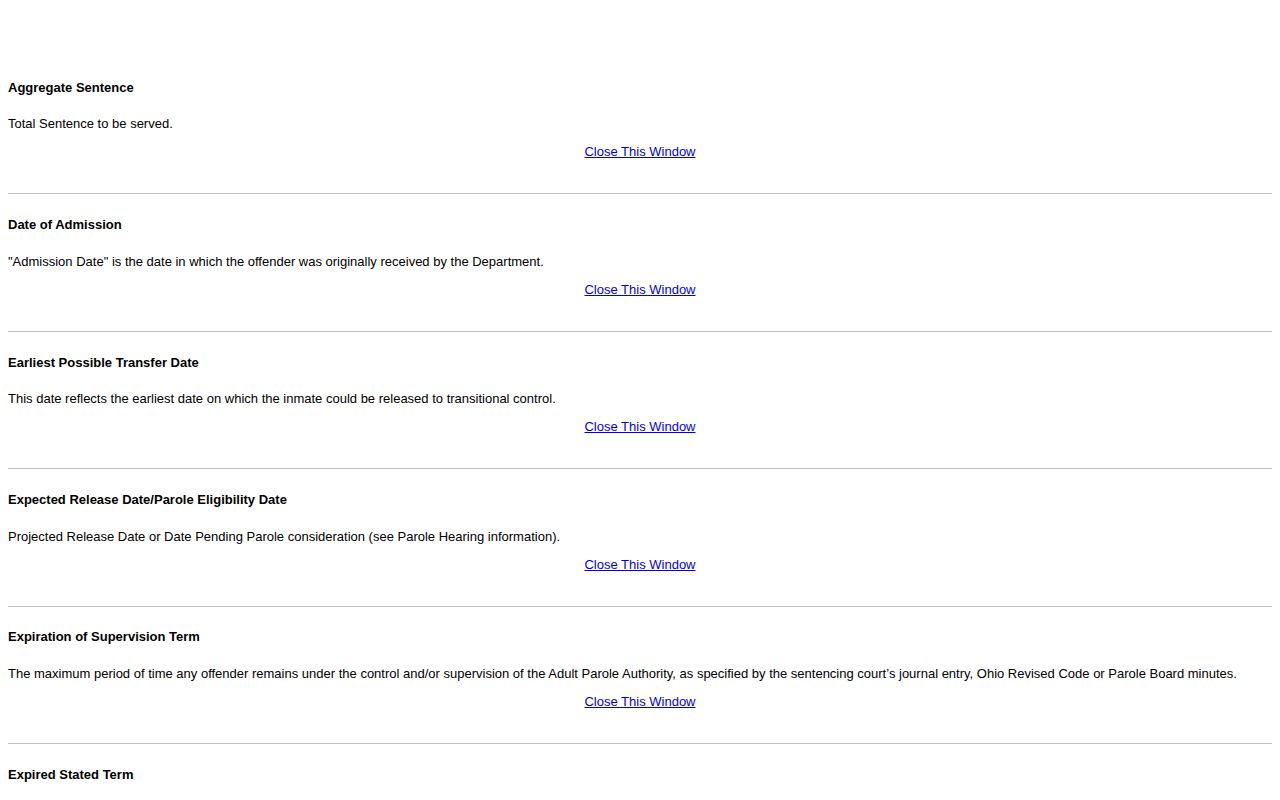
The definitions show why an expected date cannot stand alone as proof of departure. Pair it with the current status and release detail.
Lake County Has No Universal 85% Rule
Ohio does not have an accurate blanket rule that every state prisoner serves 85 percent of a sentence. ORC 2967.194, effective for the current earned-credit structure beginning April 4, 2024, allows eligible people to provisionally earn one or five days per completed month for approved work and programs. Certain completion awards can also apply. OAC 5120-2-06 implements the statute.
The aggregate ordinary participation and completion credit is capped at 15 percent of the stated prison term. That ceiling can make 85 percent a theoretical lower bound for this one credit category when the person and sentence are eligible. Credit must be earned. It is not automatic, and it may be denied or withdrawn after violations. The law excludes many categories, including specified mandatory terms, murder and related life terms, life without parole, many sexually oriented offense sentences, post-release-control violation terms, and risk-reduction sentences.
Other rules follow different tracks. Judicial release, indefinite-sentence presumptions, discretionary parole, jail-time credit, mandatory portions, and legacy sentences are not transformed into a universal 85 percent formula. Historical ODRC language about older good time must not be applied to a modern conviction. The offense date, sentence entry, mandatory terms, and applicable statute control.
Note: Lake County sentence entries and ODRC calculations must be read together when jail-time credit or consecutive terms affect the expected date.
Lake County Prison Jail-Time Credit
For an ODRC term, ORC 2967.191 requires a reduction for related pretrial and other confinement credit determined by the sentencing court. The Bureau of Sentence Computation uses the sentencing entry under OAC 5120-2-04. ODRC may display Jail Time Credit, but the judge's certified entry remains the legal source.
If the number of days is disputed, the issue generally returns to the sentencing court for a corrected or amended entry. The sheriff cannot rewrite the court's credit award, and ODRC cannot be expected to count days that the controlling entry omits. Concurrent terms run together. Consecutive terms aggregate. Mandatory years may block reductions that do not apply to mandatory portions.
A detainer can also alter the destination on the expected date. A detainer is a request or hold from another authority. It may result in transfer rather than entry into the community, even if the original Lake County or ODRC term has reached its scheduled end.
Lake County Jail Release Computation
A local jail sentence uses a different calculation. Under ORC 2949.08, the conviction record must state related prior-confinement days and the jailer must subtract them. A day counts when confinement totals more than eight hours that day. The certified court credit is the starting point, not an estimate made from arrest and hearing dates.
ORC 2947.151 permits a sheriff to recommend a work-based reduction. The possible scale is up to three days per 30 days for a sentence of 90 days or less, four days per 30 days for more than 90 days through six months, and five days per 30 days for a term longer than six months. A recommendation only takes effect with written concurrence from the presiding or sentencing judge or magistrate.
That county-jail provision is not automatic good time. It also is not an 85 percent rule. The Lake County Sheriff phone directory lists Jail Records at 440-350-5509 and 440-350-5956 for the operational record, while the sentencing court supplies the legal entry. The Lake County Adult Detention Facility is at 104 East Erie Street, Painesville, OH 44077, and its main number is 440-350-5601.
When Lake County Sentence Releases Occur
Lake County's jail FAQ adds a distinct local timing point. A person who completes a sentence is released at the time of day at which that person was booked. This differs from the bond process, which can take minutes to hours while staff await and process court paperwork. The FAQ does not establish a single morning, evening, or midnight release batch.
Confirm the current practice before making transportation plans because the FAQ is an older official document. A corrected credit entry, amended court order, written approval of a work reduction, or a new hold can change the operational result. A hold may change destination without extending a fully served sentence under the original authority.
Note: Lake County publishes no fixed daily batch time for release, and a court order may precede physical processing at the jail.
Why Lake County Release Dates Change
A projected date can move because the input or legal framework changes. Some changes shorten the expected term. Others postpone release, set a new review, or send the person to another custodian. The agency record should show which factor applies.
| Factor | Possible effect | Best confirmation |
|---|---|---|
| Earned credit | May reduce an eligible stated term within statutory limits | ODRC sentence computation and ORC 2967.194 |
| Credit denied or withdrawn | Expected date may move later | ODRC record and applicable decision |
| Corrected jail-time credit | Sentence computation changes | Amended sentencing entry |
| Concurrent or consecutive structure | Terms run together or aggregate | Judgment entry |
| Parole decision | Release may be granted, denied, continued, or rescinded | ODRC record and Board minute |
| Detainer or hold | Destination changes to another authority | Jail, court, and receiving agency |
| Judicial release | Court authorizes an earlier prison departure | Lake County docket and ODRC detail |
The table separates changes to sentence math from changes to destination. Earned credit or a corrected court entry can alter the calculation. A detainer may leave the calculated end intact while requiring transfer to another authority. Parole and judicial release follow their own decision rules, so neither should be estimated from a simple percentage of the stated term.
Confirm the Lake County Actual Release
For a state case, wait for ODRC current status and Parole or Release Detail to reflect the event. If supervision begins, note that date separately. For a county jail case, the sheriff's year-to-date release register can affirm a recorded departure date, but it does not show time, reason, or destination. Call Jail Records or request the booking and release sheet when those fields matter.
Ohio VINELink can send a custody-change notice for a registered in-custody record. The full registration and PIN workflow appears in the Lake County VINELink Check. VINE can lag and is not the legal release document. For an ambiguous transfer, read the court docket and search the receiving system before describing the person as back in the community.